Wednesday, March 27, 2013

BACKGROUND CHECKS FOR POT


This linked video obviously focuses on pointing out how easy it is to do a background check before purchasing a gun, but if you listen to Mark Giffords read off the questions asked in that background check, this video actually offers up a separate issue as well. The questions asked are pretty straightforward and have obvious relevance.

One question however should bring up a whole list of questions that should be asked in return.

https://www.youtube.com/watch?v=nL-wSweBEVc&feature=player_embedded

When the background check asks - "Are you an unlawful user addicted to marijuana?" - my reaction is - what fool thinks that marijuana is a lone substance that if over-used will lead to gun owners using their firearms in an inappropriate, reactionary way that will put others at risk?

Why is marijuana singled out? Frankly, I am far more concerned about a firearm owned by someone addicted to alcohol, cocaine, LSD, or even legal drugs sold to adults every day on the television. Ask your doctor if this drug is right for you. This drug that spends half the commercial listing all the side-effects, often including depression, and thoughts of suicide, etc. etc. How in the world is marijuana use the concern in relation to gun ownership when its side effects are primarily the munchies, and calmness. Even for those who respond with paranoia, I think the threat of gun mis-use would be far less than virtually any other drug, legal or not.


I must disclose that no, I do not have direct experience with marijuana. I have yet to try it. I have however seen people use it, and even in the extreme cases of such use that I have seen, the effect of marijuana made them actually far more trustworthy in regards to inappropriate acts of passion - like with a firearm.

In fact, I have yet to see any evidence that marijuana use, even over-use, warrants more concern with regards to mis-use of a firearm. I have in fact seen the exact opposite. I have seen a single inhale convert very stressed, angry and reactionary moods virtually instantly into far calmer, more rational thought processes.

Despite the evidence though, I still have no desire to use marijuana myself. I have however made a vow, that come age 60, regardless of any medical need or not, I do plan to try it for myself. I am now 45. I honestly think that by the time I try it, we will have ended this insane, costly and destructive prohibition against a natural plant.


Wednesday, March 13, 2013

THE SMOKE IS WHITE


Fox is the only major network not broadcasting the white smoke. (That's Fox entertainment network, not FoxNews.)

But the biggest point that stands out to me now is the false separation between many people of strong Christian faith and those who put little focus on religion. 

Religiosity covers a vastly wide scale. There is the quiet believer who seeks zero attention for his personal connection to God (and Jesus). There are the Bible-thumpers who are at "war" with the world for not having Christianity a required aspect of everyone's daily life.

There is a strange disconnect in comparing the latter group to the America around us. Just look at television media. Even the most liberal outlet has virtually hourly coverage of pundits eagerly discussing who the next Pope may be. Now (with the exception of Fox who is airing the Ricki Lake Show), every major tv network with a national news dept. is covering the white smoke with the same intensity of a Presidential election.

Don't get me wrong. I know announcing a new Pope is a huge moment for any Christian, but that's the point. America is filled with Christians. Quiet Christians and loud spotlight Christians. Your political affiliation does not matter. As a Christian, you personally follow the teachings of Jesus. In America as a Christian, you are an overwhelming majority.

Yet this false American Christian persecution-complex does not go away. Granted, it is kept alive by wealthy talking heads who profit from selling such an idea as a "War on Christmas", but the absurdity being sold does only damage to bringing focus on the good that can be achieved through church programs. When those profiting off of selling their fictional "War on Christmas" also advocate for cutting programs that do what Jesus actually taught, the good of the church only gets buried further from view. 

The big disconnect between Sarah Palin announcing her new book on the "War on Christmas" and the national attention on the just-announced Pope is one that is hard to swallow.

With that false divide addressed, I only hope that once all the spectacle of ushering in the new Pope has passed, the church truly helps lead a focus on what Jesus concerned himself with the most. Unconditional compassion and a nonjudgmental helping hand to the least amongst us.

Sunday, March 10, 2013

A FILIBUSTER "VICTORY"


Senator Rand Paul's 13 hour filibuster show on the floor of the Senate produced a sea change in Washington, but it's not the victory he thinks it is.

Paul (and others) set out to seek more public knowledge of the drone program. The focus then shifted to a search to hear that no drones would ever be used on Americans on American soil.

First Sen. Paul got a statement from Attorney General Eric Holder that drones would not be used on Americans on American soil unless the most extraordinary circumstances arise. Holder cited two examples that could meet that criteria - Pearl Harbor and the attack of Sept. 11, 2001.

This was not good enough for Sen. Paul. To his questioning, he wanted to hear an absolute answer of no. He spent almost 13 hours filibustering on the floor of the Senate in an attempt to get such an answer.

In the end, he got a very brief letter from Holder, who clarified that the President does not have the authority to use weaponized drones to kill an American who is "not engaged in combat on American soil". 

Sen. Paul declared that simple statement a "victory" of his filibuster, even though it offered no new elucidations. Paul erroneously summarized Holder's statement as "…the President is not going to kill unarmed Americans on American soil." 

That simple substitution of Holder's word choice of "not engaged in combat" with Paul's choice of "unarmed" allows Sen. Paul to conveniently overlook the fact that one does not necessarily have to be "armed" to be in "engaged in combat". Then again, it may be a simple language oversight on Sen. Paul's behalf. Note his words from a FoxNews interview on 3/6/13 -

"The thing about the drone strike program is - we're not talking about someone's actively attacking America. We're not talking about planes flying into the World Trade Center. What we're talking about is you're eating dinner in your house. You're eating at a cafe, or you're walking down the road. That's when these drone strikes can occur. It's not about people involved in combat. It's about people who they think might be." - http://www.politico.com/multimedia/video/2013/03/rand-paul-drone-strike-during-dinner-.html

Sen. Paul's expectation that an enemy combatant must be in the act of murder in order to warrant the enemy combatant label brings on just as many questions to be asked of Sen. Paul as he is asking of the administration over the drone program. As Holder alluded to, in the event a hijacked plane is heading towards the White House, does this warrant the drone use? Even if the plane is known to hold 100 US citizens? Just what does it take to warrant the "enemy combatant" label? Are there circumstances where the resulting innocent American deaths on American soil would be a tragic, yet "better" choice than allowing an enemy combatant to complete an act of terror?

Neither Bush nor Obama have used the presence of "arms" on an individual to determine if someone is an enemy combatant of the United States. (If Sen. Paul believes the simple presence of "arms" on a person warrants the combatant label, then there are about to be some wild twists in the gun control debate.)

As Holder explained in the first place, (and still left open in the letter that then satisfied Sen. Paul), even with a clear policy of not using weaponized drones on American soil, we cannot define every possible worst case scenario. Even though the use of drone missile strikes on US soil is ruled out, we cannot rule out their use on (or above) American soil in the event of such extraordinary extreme cases.

The technical difference between what Holder actually said, and how Sen. Paul paraphrased those words still allows use of drone attack on an American on American soil in an extreme circumstance. Highly unlikely of course. Maybe even more unlikely than the electoral vote and the popular vote producing different outcomes, but still, the technical difference does not exclude the possibility.

Though Holder's brief letter to Sen. Paul did not give him the absolute answer he sought, it did however give Sen. Paul the wherewithal to move on. 

Despite the technical differences in what they both actually said, Holder's brief letter allowed Sen. Paul the opportunity to infer that his "demands" were met. Using that letter to suggest such a "victory" is exactly what Rand Paul did.


If you enjoy this blog, please consider donating towards it support.
Just click on the donate button to the right.
Even the smallest contributions are received with the greatest appreciation.


I'm not so sure Sen. Paul really wanted to continue his mission to bring "public humiliation" (his words) to the White House any further. Despite the political bravado, even Sen. Paul could see he reached the point of diminishing returns in his crusade.

Just like Rush Limbaugh and other talking heads who must fill hours of time ruminating aloud on far-right talking points, the valid essences are quickly covered. The bulk of the talking time is used on the ridiculous. Sen. Rand Paul's near-13 hour filibuster was no different. 

There are valid points to address here for sure. Just like there were when Bush ran the drone program. Issues of oversight and clarifying just how far such Presidential authority goes in using the technology are very valid debates. Drifting so far from those points into the realm of absurd right-wing fear-mongering is another. Suggesting that a President would have the authority to kill Jane Fonda with a drone strike, or land a missile from a drone on Kent State is ridiculous. Droning on with tired Hitler comparisons is pathetic. Arguing that the President thinks he can kill US citizens with drone strikes as they sit at a cafe, or walk down the street is nothing more than preposterous fabrication. Yet these all made up part of Sen. Paul's near-13 hour filibuster show.

Such inane anti-government arguments are nothing new. The Hellfire-missile-coming-to-your-door style of paranoia is applied in the most cockamamie conspiracy theories. Take the census for example. Just a few years ago, Alex Jones was selling the Constitutionally-bound once-a-decade undertaking as an excuse to aim Hellfire missiles at your front door. Note the following text from Alex Jones' infowars.com website in March 2010.

“Given the history of the US Federal government, at Waco with the Branch Davidians, at Ruby Ridge among others, you will excuse me that I am not buying the Census story....The reason is simple…They, whoever you think “they” are, intend to kill you for your political, religious and cultural views. And they intend to do it in the most intense “shock and awe” manner they can....So, when a HELLFIRE missile shows up at your front door, don’t say I didn’t warn you.”

But that's Alex Jones - the king of anti-government conspiracy theories. He can rail for hours about such ridiculous offerings. 

Glenn Beck also chimed in on the census saying - "Today they're asking the race question to try to increase slavery."

This type of nonsense, when given voice on the floors of Congress, does not match the quantity or length that Conservative shock-jocks devote to it on a daily basis. Its Congressional appearances are also quickly met with voices of reason. Soundbites are extracted and played on various media to mock not only the Congressional member who uttered it, but their affiliated Party.

Sen. Rand Paul's filibuster offered numerous such soundbites. So many in fact, that it was not just Liberals or Democrats taking note. Ranking Republicans noted the damage being done. They actually had to engage in damage control and take to the floor to oppose the ridiculous rhetoric.

Lindsey Graham spoke out about the hypocrisy of fellow Republicans now getting worked up against the drone program. He pointed out that Republicans had no problem with Bush having the drone program, and that Democrats were not outspoken against Bush’s drone program.
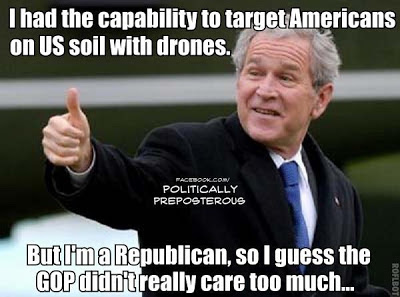
Amazingly, in response to Rand Paul's filibuster,
LINDSEY GRAHAM
actually made this point on the floor of the Senate.
Thanks to Politically Preposterous for use of this meme.

Graham's objections to fellow Republicans here stems from two separate concerns.

First, he can read the writing on the wall about how dangerous the optics are in Republicans' pushing the over-the-top rhetoric. It was just last year that Graham told the Washington Post "The demographics race we're losing badly. We're not generating enough angry white guys to stay in business for the long term."

Secondly, attacking the drone program is a snub to the neo-con ideology of military intervention. 

President Obama has said from the start of his first Presidential campaign that he would use the military in more efficient manner. Large troop presence would not occur when Special Forces can effect an equal or better outcome. He has held true to his word. He has increased our Special Forces, and he has deployed them many times with great success. The Somalian pirates and the bin laden raid are two of the most prominent examples. These crucial affairs were not dealt with by going to war with Pakistan or Somalia. They were handled by elite forces. 

President Obama truly reserves war for the last resort. Diplomacy, Special Forces, air power, and yes, drones make up his primary arsenal in handling sticky foreign affairs. 

Some neo-con personalities have a problem with this, and have a hard time learning the lessons of how costly and deadly the entanglements are that arise from jumping too quickly to a "boots on the ground" strategy. Voices whined about "leading from behind" over President Obama's handling of Libya. FoxNews personalities decried it "unnatural". 

Rand Paul is not a neo-con. He is a pure Libertarian. There is an ideological divide between the two. An absolute Libertarian sees spending on wars a poor choice and a waste of money. Bring everyone home, then secure the borders. Spend what you need to make the borders tight, then stop spending money on war and foreign affairs.

To highlight the gap in ideology between these two factions of the Republican Party, note this exchange between Paul Krugman and Rand Paul.

On ABC's This Week in Sept of 2012, Krugman pointed out how Romney's ad campaigns were claiming government spending can't create jobs, while simultaneously claiming Obama was trying to cut defense spending. The Romney ads argued that defense spending should not be cut because… that would cost jobs. Rand Paul replied "That's an inconsistency and it's wrong. They are accepting Keynes with regards to military spending, but not with regards to…"

The Libertarian constitution of Rand Paul would view the drone program overseas a waste of money on unnecessary military imperialism. His ideology would also then see no need for such a program domestically.

The neo-con ideology would have a different perspective. To the neo-con constitution, the drone program would be seen as vital military defense. Especially given President Obama's opposition to heavy troop deployments.

Note Lindsey Graham's words - 

“So what is it all of a sudden that this drone program has gotten every Republican so spun up… To my party, I’m a bit disappointed that you no longer apparently think we’re at war.”

Then there is John McCain, who stood on the floor and called Sen. Paul's questions and assertions "ridiculous". 

No stranger to trying to balance support of the right-wing fringe without creating a monster, McCain recognized the damage being done by an unchecked near-13 hour tirade chock full of anti-government paranoia soundbites. “We’ve done a, I think, a disservice to a lot of Americans, by making them believe that somehow they’re in danger from their government. They’re not.” said McCain.

No matter the negatives involved, we all owe Sen. Rand Paul a thank you for literally taking a stand and offering a REAL filibuster.

Whether focusing on a crucial oversight, a ridiculous delusion, or even a mix of the two, a REAL filibuster sparks a national dialogue that goes way beyond the sensationalized headlines. In the last few years, we have failed to see that happen. 

Instead, we experienced a record number of silent filibusters. They have the same effect of stopping movement in Congress, but they lack any debate. They not only lack debate, they usually lack any transparency. A single member of Congress can literally call in a silent filibuster from home without offering any reason, and due to the anonymity, they also receive no repercussion. That is the silent filibuster.

It is a blatant abuse and over-extension of legislative privilege. It abuses the intended protection from potential tyranny of the majority and creates from it, at the very least, blatant guerilla obstruction from the minority. Some would call that act tyranny itself. Tyranny by the minority.
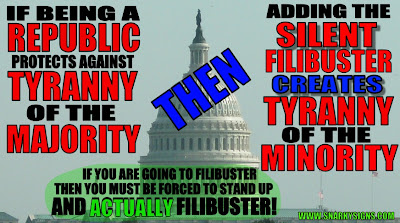
Sen. Rand Paul's ACTUAL filibuster was the first in a long time.


Yet this formula has been used ad nauseam in the last few years. 

It is the silent part of that recent construction known as the silent filibuster that causes so much damage. 

It minimizes real debate. Reporting is minimal, if existent at all. The result is simplistic and sensationalized misinformation that only seeds irrational rumors. Without requiring extensive nonstop speaking on the floors of Congress to effect a filibuster, the full "debate" fails to spill out beyond the beltway. 

In fact, the silent filibuster keeps the full "debate" from even happening within Congress itself. Had we not seen the spectacle of Rand Paul going on for almost 13 hours, but instead experienced yet another silent filibuster, it is virtually a given that we would not have heard Lindsey Graham and John McCain be forced to speak up in opposition. More likely, a silent filibuster would have kept the new status quo of simply sidestepping the actual debate while giving a metaphorical wink to the extreme rhetoric.


If you enjoy this blog, please consider donating towards it support.
Just scroll back to the top, and click on the donate button to the right.
Even the smallest contributions are received with the greatest appreciation.


So Rand Paul, I thank you.

Your actual filibuster forced actual debate. That is a very good thing. It brought focus to what oversight, or at the least, what knowledge, the American people should have regarding the use of deadly force in our name. It brought debate on the limits of executive power. All things that we continually must keep in check. By extension, your filibuster brought contemplation of our national defense outside (and inside) our borders. I don't think we can simply seal our borders and forget the rest of the world. I also know we can't go the other extreme living in eternal war all around the globe. 

No matter the President at the time, there will always be enemy combatants that require action to protect our national security. Many of us may like to overlook that fact and avoid the reality altogether until forced to consider it amidst a national dialogue. 

Your filibuster brought such a national dialogue, and for those willing to engage, they must consider the costs and risks of various foreign policies and actions. We must compare the outcomes and entanglements of flat-out war to those of doing nothing. We must compare those extremes to the current use of Special Forces, intelligence and drone strikes. No policy will ever be perfect, and frankly doing nothing is not an option. I personally see the current policies as far more efficient and effective than the all-out war approach of our last President. I imagine I am hardly the only one. Especially as anyone truly focusing on your filibuster is then forced to weigh all these concerns. 

But many already have considered these issues. Many actually voted for Barack Obama because he offered this policy approach from the beginning of his first campaign. He was actually mocked for it, but so far the approach has successfully dealt with numerous global challenges without resorting to more American war entanglements. 

For millions then, that leaves your ridiculous rhetoric of Hitler and Jane Fonda and Kent State and cafe killings and Hellfire-missiles-aimed-at-your-door as the biggest takeaway from your filibuster.

Senator Rand Paul, you claimed a "victory" of getting the answer you sought, despite Eric Holder's letter to you technically offering nothing more than did his original statements. Feel complacent in your assessment that your near-13 hour show brought "public humiliation" to our current administration. No matter how you self-evaluate your performance, the fact is that your filibuster, in bringing forth actual debate, also forced fellow Republicans to stand up against your tirade and take a stance against the extreme ridiculous fear-mongering rhetoric that has been leading the Republican Party for years. 

The most consequential "victory" from your filibuster is not the brief letter from Eric Holder, it is the result of making it now acceptable for Republicans to publicly take a stance against the extremes of tea party rhetoric. 

Throw in the ideological divide between the jingoism of Neo-Conservatives and the shrink-government-at-all-costs ideology of Libertarianism, and the acceptability of Republicans to speak openly in condemnation of such extreme rhetoric intensifies into an imperative.

THAT is the ultimate "victory" of Senator Rand Paul's filibuster.


Wednesday, February 13, 2013

SINCE SANDY HOOK


At three different times last month, I asked a different relative to guess how many gun deaths there have been since the Sandy Hook tragedy. None knew what the others had guessed, or even that I had asked the question of anyone but them. Strangely, the three answers differed only by how many zeros the number included. 

One guessed 3.

One guessed 30.

Another guessed 300.

Suffice it say all three answers fell far short.

Most news outlets rarely even report on the thirty or so daily gun deaths in America, yet focus heavily on the mall and school shootings. This helps implant a false sense of the true scope of the problem of gun violence in America.

I also think this is finally beginning to change. Slowly yes, but I think much of America is waking up to the seriousness of just how many gun deaths we have every day. We are starting to wake to just how quickly that adds up every week, every month, and just how devastatingly huge those numbers are when accumulated over the course of a year.

Sadly though, much of the nation is in denial of the true scope of this problem. One of the biggest hurdles to doing anything to truly address the problem is to first acknowledge the true scope of the daily tragedy of American gun deaths.

I offer anyone to seek out the daily, the weekly, the monthly, the yearly count of American gun deaths. The numbers are so high that even the callous rhetoric of dismissing up to half of them because they are "just suicides", cannot diminish the scope of the tragedy. 

I offer you the idea of repeating the same unofficial poll I did. 

First, gather the latest daily update by googling the phrase "how many gun deaths since sandy hook".

Then ask friends and relatives how many people they think have died from guns in America since the Sandy Hook tragedy. How far off do you think they will be?

Thursday, January 31, 2013

CONGRESS AND GUN VIOLENCE


Except for the first 15 or so minutes, I saw the entire hearing today on addressing gun violence. 

I listened to Wayne LaPierre continually assert that we can never ensure background checks on every gun purchase, thus we should not bother ending that loophole in gun shows.

I listened to Lindsey Graham arguing that 6 bullets in a gun may not be enough for a woman to use in self defense. Why? Because the one story he told about a woman defending herself from a home invader involved all 6 bullets. One missed the criminal, and though the other five bullets hit him, he did not die, and he ran away. What if there were more than one invader? OK. So what about 10 bullets? Nope. Lindsey Graham thinks 15 might be too few bullets for a woman to protect against violent home invaders.

What about 100 bullets? Can we at least agree that a weapon that can fire 100 bullets is way more than what is necessary for a woman with screaming babies to fight back against violent home invaders? Nope. According to Gayle Trotter, we cannot even make that argument, for it is a matter of being pro-women's choice. According to her, women should be free to choose however much firepower they see fit for future home invasions.


And I listened to Lindsey Graham also argue that tight budgets will absolutely cut police forces across the nation. Thus we will all need to become our own individual law enforcement and protection in time of trouble, so we better not limit the firepower available to the average Jane or Joe. 

I listened to Wayne LaPierre argue that the 2nd Amendment exists for two reasons, One, to protect against too much government that he abstractly defines as tyranny, and two, to protect against too little government that allows a lack of law and order. 

So no matter what government does or does not do, we must increase personal firepower to be armed against its actions or its inactions. (Amazing how gun manufacturers make out so well in this loop of logic.)

I listened to all this for over 3 hours today. 

I admit that maybe that wasn't the brightest idea given the flu-driven headache I was already nursing, but I will say there were some moments that I would portray as pretty bright.

Baltimore County Police Chief James Johnson stated that "The common sense measures we call for will not infringe on the 2nd Amendment rights, but will keep guns out of the dangerous hands of people who are out there to commit danger in our society."

First, and foremost, he argues we must end the background check loophole for gun shows and person to person sales. Second, he supports a 10 round maximum capacity. Thirdly, he supports Dianne Feinstein's bill.

Now that my headache is finally subsiding, I am able to type out these "highlights" for you of today's hearing. But having nothing to do with the flu, I now feel like I need to vomit as I realize these "arguments" really did happen today.

Sunday, December 16, 2012

RIGHT TO BEAR ARMS VS. RIGHT TO LIFE


I have remained quiet so far on the issue of guns. 

My silence is not however because I have no feelings or opinions on guns and the deeply engrained place they hold in our culture. While my ballistics knowledge may be far from encyclopedic, my silence on guns does not stem from a lack of looking at any of the wide selection of statistics and facts available to make one's point.

My silence thus far on guns comes merely from frustration.

The issue has been "debated" tirelessly. All points of consideration have been put forth. Everything has already been said. 

Yet despite all the statistics repeatedly showing the unceasing deathly effects of our insane American gun culture, tools of the NRA will ONLY acknowledge studies suggesting a correlation between gun control and increases in crime. They shout this talking point loudly enough to be certain the bigger picture is either overlooked or simply unrecognized. America has a serious problem with guns. Google the numbers yourself. Compare gun deaths in America to gun deaths in other "civilized" nations. Those statistics can no longer be ignored or silenced in the war of perception on gun control issues.

Invariably, every time someone tries to address the issue, we hear the auto-responses about how it is "too early" or "don't politicize the tragedy". Sorry NRA tools. When there are more national gun tragedies than national holidays, thus making it ALWAYS "too early" to talk about it, then your trying to silence the honest discussion about guns in America IS the politicization of the tragedy.

Speaking of politics and NRA tools, what inspired me to start writing this very post was seeing Bob Schieffer this morning say that NO Republicans would come on Face The Nation today. EVERY ONE of them said they either had a scheduling conflict, or flatly said no.

At least for once, the severity of the gun issue is being discussed without being drowned out by the auto-response cries intended to silence an honest discussion about how the right to life needs to be brought back into balance with the right to bear arms.


I for one have no desire to eliminate the right to bear arms.

We are far beyond that now however as we allow individuals to arm themselves with weapons of mass destruction.

Exactly where we draw the lines and how we craft the regulations concerning allowable civilian firepower and require the burden of proof of responsible gun ownership, (including mental health and mechanical proficiency) is yet to be worked out. But it is WAY beyond time to finally bring the right to bear arms back into balance.

To see more thought provoking images, visit SnarkySigns on Facebook.
Be sure to "Like" the page.

Monday, December 10, 2012

PAPA JOHN'S POSTAL SERVICE-PART 2


In Part 1, proposed anti-Obamacare actions by some food-chain owners were covered in detail. So too was the even larger backlash against these politicized comments.

Since that posting, the scope and damage of the backlash against food chains offering anti-Obamacare shortcuts has proven even larger. As reported by Forbes, 1 the public perception rating for a business or brand known as the "buzz", has dropped dramatically for all restaurant brands playing this game.

Papa John's' buzz score dropped from 32 to 4! YouGov BrandIndex, the market research company responsible for polling the buzz ratings, says this this the sharpest drop of the year, and it brings Papa John's well below Pizza Hut's buzz rating.2 After Papa John's tripled their stock price during the Obama years, to now drop so far below their competitors has to cause some serious re-thinking.

Then there is Applebees' buzz rating. Before Zane Tankel's comments, it was 35. Now it is 5! Even though Zane Tankel doesn't speak for all Appleebees (he runs 40 of them in the New York area), the backlash against his anti-Obamacare comments on a FoxNews interview have harmed the entire Applebees brand.

Jimmy John's has no buzz ratings to compare. But at least one Minneapolis franchisee has a long standing issue with healthcare and public perception.3 Well over a year ago, workers attempting to unionize eventually went public with the franchisee's policy to economically punish workers who call in sick with no substitute. Those whistleblowers were fired. In April of this year, a federal administrative law judge ruled that the fired workers are to be reinstated with back pay. Now the appeals process may drag out for years. In a side note, in Oct 2010, that unionization attempt narrowly failed in an 85-87 vote.

Denny's fared the best. Though Denny's buzz score dropped from 10 to 0, it did rebound back to a 6. Presumably because after franchisee John Metz proposed a 5% Obamacare surcharge to all his customers saying they should then reduce their tip accordingly if they don't like it, Denny's CEO was quick to respond that such views and actions were "inconsistent" with the Denny's brand. It must be pointed out that even with Denny's drop to 0, the resulting rebound stunningly gives Denny's a higher buzz rating than both Papa John's and Applebees. 2

Then there is Darden Restaurants. Their "experiments" with reducing workers to just 28 hours/week in order to avoid any healthcare responsibility under the Affordable Care Act ("Obamacare") have proven a bad choice. We do know that they expect at least some loss. They are lowering their projected profit, citing in part the backlash against their anti-Obamacare experiments.1

On Dec. 6, Darden announced they were done with their experiments, and would proceed no further with the idea of reducing workers' hours. Darden CEO Clarence Otis said "...we are pleased we know enough at this point to make firm and hopefully reassuring commitments to our full-time employees."4 Additionally, they released the following results of their "experiments":


  • None of Darden's current full-time employees, hourly or salaried, will have their full-time status changed as a result of healthcare reform.
  • Each of Darden's new and existing restaurants will have full-time hourly employees because that is what it takes to fully deliver the experiences guests expect.
  • In 2014, all of Darden's full-time employees, including hourly, salaried and executive employees, will have access to the same insurance plan coverage.

  • 3 out of 4 restaurants surrounding this mall are Darden Restaurants


    Yet even with all this detail of political games played and lost over "Obamacare" in the food indsutry, the bigger more crucial pictures are still missed. 

    Business owners, restauranteur or otherwise, are right to complain that they must bear the burden of providing healthcare. Employees are right to complain that access to healthcare requires an indentured servitude to their employer.

    As Americans, we pride ourselves on our freedom to choose one's own path, yet we are the civilized nation that establishes a healthcare system interminably tied to a profit-driven industry, then makes access to even that industry a condition of employment loyalty. Many may miss the hypocrisy there, but it only takes a moment of thought to comprehend the absurdity of it all.

    There is an underlying entrepreneurial psyche of the nation for each to make one's own way and become a great financial success. Yet despite that proud ever-present element of the American dream, the American economy ironically relies far more heavily on the majority of its citizens to be loyal workers and not entrepreneurs.

    It could be argued (however nebulously) that at one time, tying such an elemental need like healthcare access to the employer/employee relationship served the purpose of business owners. When wages allowed one to raise a family on the single income while simultaneously providing the peace of mind over healthcare access for the whole family, company loyalty and thus a stable workforce was fairly well secured.

    That was then.

    We now have a different economy. Different players. Different culture. Different rules. A different equation all together. 

    Healthcare tied to one's employer plus global competition plus lower wages and higher healthcare costs. What little tenuous argument there once was for tying healthcare access to the employer/employee relationship no longer serves any useful purpose. Instead, that link stifles the entrepreneurial spirit, and helps further the wealth gap to new extremes. It does not help stabilize a workforce and a nation's economy. It does only harm to the entire nation.

    It is such a high-risk endeavor to break free of that reliance on one's employer and act on entrepreneurial dreams and ideas, that few will dare try. Instead, out of necessity, most Americans show a loyalty to their employer for fear of losing what degree of healthcare coverage they do have. Risk losing that and it takes but one serious illness to completely wipe out a lifetime of family savings. Simply put, we have institutionalized a pathway to stagnation.

    Now that we also institutionalized sending jobs overseas; first by advancing the technology that allows that to be a serious option, and secondly by writing laws and tax code that actually rewards moving jobs outside of America, we now have a buyer's market for labor. Even for those jobs that cannot be outsourced, the demand for jobs in America is now so high, that even at minimum wage, a business owner has no problem quickly filling any job positions.

    Economic structures that prioritize long-term stability of the nation's middle-class work force have been replaced with the culture of short-term top-end financial gain. These ill-conceived priorities have become deeply entrenched in a minority of legislators. So much so that despite mountains of evidence over decades to the contrary, they insist that such an ideology of immediately expanding wealth at the top magically transforms into an abundance of American jobs and growth of the middle-class.

    Despite getting 51 votes, Republicans filibustered the Buffett Rule,
    requiring 60 votes to pass. The bill would have required a minimum
    tax rate of 30 percent on individuals making over a million dollars a year.
    Mitt Romney famously paid only 17 percent.

    The degree to which these legislators hold themselves in bondage to such absolute ideology is blatantly clear from all the recent budget battles, including the current Congressional "fiscal cliff" fight. Despite saying they also want tax cuts for the middle class as well as the wealthy, they refuse to allow ANY tax cuts unless they can guarantee that the wealthiest Americans get ADDITIONAL tax cuts for their income over $250,000!

    What fuels such thinking is a simplistic and absolute interpretation of role of government. It is the idea that government can not do anything well or better than the individual or the "free market".

    It is summed up by the oft-repeated quote from Ronald Reagan. "Government is not the solution to our problem, government IS the problem."


    Remove that quote from the inaugural address as a whole and place it as a foundational prime directive. This is the fallacious ideology that has infected too many, including some recent legislators. 

    Take that Reagan excerpt as an absolute, and you create the rage that was core to much of the tea party movement.

    As much as Ronald Reagan may have railed against government becoming too big, cumbersome and expensive, the fuller context of his first inaugural speech must be noted. It contained many more than just those twelve words. In fact, those famous words were not even the entire sentence. Play the embedded video above and hear for yourself. The quote begins - "In this present crisis..."

    The present crisis he was discussing was a bad economy. Even in stating that government is the problem in that particular crisis, this did not mean Reagan was calling to eliminate or even decimate government role. 

    But steadfast adherences to such small government ideology since the days of Ronald Reagan have transmogrified into the simplistic manifestos of Grover Norquist and his followers of the no-tax hike pledge. Having a life goal to shrink the size of government until it could be drowned in a bathtub is absolutely ridiculous, yet this is the committed singular mission for Grover. He so oversimplifies this small government/low tax ideology that he even writes "Raising taxes is what politicians do when they don't have the strength to actually govern."

    Back to Ronald Reagan, who unlike Grover Norquist, did actually have to govern. To do so effectively, he had to raise taxes multiple times, no matter how much he hated it.

    Reagan also clarified in that same inaugural speech, that despite his penchant for smaller government and lower taxes, that government had a vital role.
    "Now so there will be no misunderstanding, it's not my intention to do away with government. It is rather to make it work - work with us, not over us; to stand by our side, not ride on our back. Government can and must provide opportunity, not smother it; foster productivity, not stifle it."
    "Government can and must provide opportunity." I imagine most who preach the "...government is not the solution to our problem, government IS the problem" quote would be surprised to hear (and maybe even deny) that Ronald Reagan stated those very words in the same speech.

    But here is where the big picture comes into focus. Neither of these two quote extractions can be taken as absolutes. Balancing these two seemingly divergent statements gets to the very core of what defines effective government. The two ideas must keep each other in check.

    Of course interpreting what defines appropriate balance is the real nitty gritty work of political oversight. Right or left, both statements can be twisted to make one's case. One person's opportunity is another's exploitation. One person's "problem" with government is another's only protection from injustice. Face it. Since long before Reagan, and certainly through today, government HAS been sought as the solution for legislating nearly every viewpoint. Depending upon perspective, government action, or government inaction, could be seen as the problem.

    Take the idea of regulating the workplace. Practically any business owner will tell you that complying with all the regulations is burdensome, even if only for the time involved in keeping proper logs to verify their compliance. Yet virtually every regulation protects against some excess or abuse.

    Too often the big picture value and need for those protections are not recognized. Complaints and arguments for government reduction tend to follow. This is especially true in the realm of large business where the pressure to increase shareholder profits becomes the primary driver in deciding a business' policy and actions.

    Not that actual small business owners never rail against burdensome government regulations over how they run their business. One could find plenty of small business owners who feel that way, but there is a distinct difference between true small businesses and the very large businesses that many politicians lump under that "small business" label. For one, actual small businesses with less than 50 employees, are exempt from "Obamacare" requirements. Those with 25 or fewer employees that do provide such healthcare for their workforce will get significant tax breaks for doing so.

    Compare that to the U.S. Small Business Administration's definition of a "small business". For the retail trade they partially define "small business" as having "500 or fewer employees".5

    A Wal-Mart store has less than 500 employees.
    Should it be classified as a "small business"? 

    Seriously. Ponder the huge difference between a true Mom and Pop store to a retail store with 500 employees. Even if you divide the total number of Wal-Mart employees by the total number of Wal-Mart stores, you can't reach 500 employees per Wal-Mart store.6 Consider that reality the next time you hear a politician arguing that without tax cuts above $250,000, "small" businesses will be hurt.

    When politicians say "small business", they are not necessarily talking about a truly "small" business. Yet the policies they are trying to sell by appealing to the idea of "small" businesses will invariably present great opportunity to one at the expense of the other.

    "Government can and must provide opportunity." It always does. The problem with government is that the opportunity it provides almost always comes at the expense of someone else. When it favors opportunity to those who have already reaped great benefits of earlier opportunities, it no longer represents the land of opportunity, but the land of continued opportunity for the few.

    This has been part of the problem for some time. Opportunities sway more towards the big guy. The well-established large businesses get legislation written to their benefit. Minimum wage, tax code, double-down on trickle-down economics. No one is saying large business is not entitled to profit. Even big profit. But the wealth gap has grown exponentially out of control. CEO pay is beyond silly, yet workers' wages remain stagnant. Minimum wage is so low, there is not one city in America where a full time minimum wage worker can afford a 2-bedroom apt. If you look back in history, wealth gaps this huge always seek equilibrium. Usually at a high cost.

    Take a 2 week vacation from a minimum wage job,
    and you fall BELOW the poverty line for a family of 2.
    Even with NO hours missed in a year, a minimum wage
    job requires food assistance support just to survive.

    Yet despite this, we see increasing refusal from politicians to even acknowledge the gap, let alone the consequences for the entire nation. This cold-hearted focus on prioritizing profits at the top had plenty to do with the recent election.

    Conservative journalist Chris Ruddy stated the reason Mitt Romney lost was because people didn't like him. Howard Fineman offers this observation:
    "The reason that people didn't like Mitt Romney is that he seemed only to care about money. He seemed only to care about profit. He didn't have any communal sense to him that could be applied to government. The Republicans don't see that a pure obsession with free market economics comes across to everybody else in the country who isn't them as too cold-blooded, as too cold-hearted. And the fact that with almost 8 percent unemployment, with the people thinking that the country is going in the wrong direction, that they still voted for Barack Obama, makes it an even bigger rejection of the Republicans and conservatism than they are willing to admit to themselves."7
    No communal sense to him that could be applied to government. That description could certainly be applied to far more than just Mitt Romney. Take Congress for example. Especially those who gained their Congressional seat via the tea party wave. Even former Republican US Senator Alan Simpson has noted this trend in his recent interview on The Daily Show:
    "Now there's seventy of them - the tea party guys. These are the guys who went to Congress not to limit government, but to stop it."8
    He has a real point. Many Republican Representatives have taken the idea of government being the problem in every situation to an extreme. They rejected the very idea of compromise. They complain of government incompetence, and now that they ARE government, they are dead set to prove it.

    This anti-government free-market proposal to everything is a serious threat to the entire nation. There have always been a handful of individuals who sought to dismantle government functions and place them in the hands of private profit-driven companies. But up until now, very few of them ever infected the legislative power of Congress.

    Simply put, in order to provide and secure the infrastructure that not only allows basic function of a society but that must also be relied upon in order for there to be opportunity to many, it is integral that some functions remain squarely the responsibility of everyone via government control, and not private industry.

    This does not mean that there will be no opportunity in doing the work of these functions. The physical labor and architectural design of building roads and bridges is not done by politicians. The work is contracted out to the private sector. Yet their planning, financing, management and responsibility is the work of government. The resulting roads and bridges are thus "owned" by all of us collectively. Every one of us is reliant upon them daily. Goods and services require round-the-clock transport of people and things. Even the car-less city dweller who walks to the corner store and never travels is dependent upon the uninterrupted function of our roads and bridges simply by buying groceries. Turn that basic infrastructure over to the profit-driven private sector, and the whole system collapses.

    It's not just roads and bridges. It's also the means to get basic documents, goods, catalogs and more from point A to point B at a reasonable cost. You can't underestimate how vital it is to the entire economy to have reliable low cost delivery always available. Since even before our Constitution, we have had the USPS establishing this vital infrastructure.

    Try sending a payment by FedEx or UPS. It will cost closer to $10 than 45 cents.

    This indeed creates opportunity. Opportunity for the consumer to order goods by mail that are not otherwise available in their community. Opportunity for small businesses to sell goods to far larger markets. Opportunity for all businesses to mail promotions, catalogs, bills and payments. It even leaves the opportunity for private for-profit delivery companies to deliver all sorts of expedited goods at premium prices.

    Note that neither FedEx nor UPS are suffering. But the next time you hear someone grumble that the USPS can't compete, try comparing the flat-rate shipping options of the USPS at around $5 to the rates of FedEx and UPS. Ask them where else they can mail a letter or a check from one coast to the other for a mere 45 cents.

    Not just that, the delivery service that those few coins can purchase far surpasses the guarantees of FedEx or UPS.

    First, USPS does not refuse delivery to remote rural areas. The other guys have "no delivery" areas because delivering to those far outlying areas would cost them too much. Additionally, USPS makes every effort to forward items mailed to incomplete, or outdated addresses. No extra charge. The other guys? Not so much. You must request such address changes, and you will pay extra for it.

    Rather than sticking a 45 cent stamp on that letter or check you need to mail, try sending it via FedEx, and the rate starts at about $10. And that's only if it is being sent to a nearby region. There is real truth to the conservative comment that the USPS can't compete in the free market. Any for-profit letter carrier would instantly price itself out of the market. They couldn't even touch the USPS!

    The point that must be stressed here is the vital nature of the service the USPS offers at such low price. You will still hear some arguing that the government has no business being in the delivery market. All services that can be done by the private sector should not have competition from the public sector they will argue.

    Of course they have not considered the real effects of implementing such simplistlc absolute ideology.

    What happens if the USPS really was privatized? How does the nation handle the jump in cost to mail simple letters, documents, payments or checks from just 45 cents to $10? Even assuming that private letter carriers began to really compete and quickly became more efficient, the sudden existence of the USPS for the purpose of profit rather than vital infrastructure will exclude them from ever offering postage as cheaply as the USPS.

    Postage prices would have to be seriously increased and service would have to seriously decline. 

    First, far out rural areas will lose delivery. Period. No for-profit letter carrier is going to drive a day's drive to deliver envelopes to the farthest reaches of the boondocks. FedEx and UPS don't do it now for premium prices. 

    Consider that it costs the USPS an average of $0.513 to handle each piece of mail that is undeliverable as addressed.9 Any privatization of the USPS will require postage prices be increased well beyond this cost of operating. Then dropping the policy of trying to forward mail to the correct address would follow. Or a "Cash On Delivery" fee could be implemented on such pieces of mail. One thing that certainly would not happen is the hiring of more employees to verify that every piece of mail is correctly addressed.

    But let's even assume that a privatization of the USPS immediately got efficient enough to charge not $10 per envelope, but just $2. A very unlikely speculation given the need to not only continue some semblance of sustaining current USPS service, but also to make room for profit. Nonetheless, let's just go with that conservative estimate of postal rate increase in the event of privatizing the USPS. Consider the shock waves throughout the entire economy.

    We may send far fewer cards as a nation than we once did, but imagine how much less birthday money Grandma can afford to put in that birthday card.


    Only a small sacrifice you say? What happens to Social Security checks? Will the dramatic increase in postage costs simply be deduced from each SS check? Will it be charged to the government? If so, will those who insisted the USPS be privatized now be just as indignant that the net result is a handing over of billions of taxpayer dollars to private companies? Will the retirement age be increased just so Social Security can meet the increased cost of mailing out checks? Again, will this bother the "free-market" criers as much as the USPS did in the first place? Or will they then seek to privatize Social Security as well?

    Consider the effect on the truly small businesses that sprang from online reselling. How will such a large postage price increase affect E-Bay? or Amazon? Did you realize that right now E-Bay even works right with the USPS, offering online printing of shipping labels, and even arranging for your mail carrier to pick up your packages?

    What about the cost to businesses for mailing monthly publications? Consider the ultra low discount rates they get from the USPS not only through the media rate, but from bulk mailings. That basic cost of doing business would immediately multiply considerably.

    What about the costs for sending out credit card offers? Or membership renewal requests from non-profit organizations? Or recall notices to consumers?

    Or what about mailing promotional ads? Well, maybe that approach would still be cheaper for Papa John's, considering their $250 million class action lawsuit for illegal text message ad spamming in 2010. 

    But with a privatized USPS offering major hikes in postal rates, consider the self-defeating result. As businesses suffer these higher costs, they will do whatever they can to cut back on postal expenditures. That makes the privatized version of the USPS need even more revenues, meaning even more rate hikes. Since it would then be a private company not needing Congressional authority to institute every change, they could raise postage rates or drop services as they saw fit. It would be an economic disaster for the entire nation.

    Yet despite these realities of what a USPS privatization would mean, there is still a larger segment than usual of anti-government ideologies calling for such privatization. Considering the title of this piece, you can probably guess that Papa John's CEO John Schnatter is among that crowd.

    Schnatter has since backtracked on the anti-"Obamacare" stances and comments since the backlash has proven to cost him more financial damage than his proposed means to "... find tactics to shallow out any Obamacare costs and core strategies to pass that cost onto consumers in order to protect our shareholders' best interests...".10

    In his oped piece, Schnatter even tried to imply that he never meant such things,11 but he IS the one who complained about the 11-14 cents per pie he figured it would cost him, and until his oped pieces, he did not reject in any manner the strategy of reducing workers' hours to avoid the "Obamacare" health requirement.

    Schnatter's anti-government comments went beyond just his clearly stated opposition to the new healthcare law ("We're not supportive of Obamacare, like most businesses in our industry..."10). Schnatter also compared governmental role in health care to his perceived incompetence of governmental role in the US Postal Service, saying "the worst entity in the world for running the thing is the government."12

    I have tremendous doubt however that Schnatter has given even the smallest amount of thought into what privatization of the USPS would really mean. Either for him personally or for Papa John's, let alone how financially damaging it would be for the entire nation.

    But John Schnatter is far from the only one with such vacuous anti-USPS thoughts. The folly of this idea has invaded Congressional members. Take the boisterous one-term tea party Republican Representative Joe Walsh for example. Privatization of the USPS was not just an under-the-radar issue like it is for other tea party Congressional members, it was actually a blatant issue in Joe's campaign. Fortunately, his opponent Tammy Duckworth sees the crucial value of our USPS, and she soundly defeated him last month.

    Tammy Duckworth soundly defeated tea party one-termer Joe Walsh

    But even with a shrinking tea party faction in Congress, the USPS is still under serious threat from Congressional action steering it towards privatization.

    In 2006, Congress passed a law requiring the USPS to PRE-fund its pensions benefits by 75 years. That is not a typo. Congress requires the USPS to PRE-fund the pensions of workers who have yet to be born!

    To achieve this intensely unique requirement, they are now obligated to pay $5.5 Billion in to this fund EVERY year until that extraordinary goal is reached!13 This is a 10 year plan. This immense and singular burden is now beginning to seriously take its toll.

    The resulting financial burden unsurprisingly now has the USPS running deficits. They do not have the power to simply raise the price of stamps, or offer new services like internet cafes, etc.. The USPS is an unusual construction. It is under control of Congress, yet receives no taxpayer money. Its operating funds come from postage and delivery fees. Despite the lack of Congressional funding, Congress must approve all changes.

    That is not an easy task. Particularly when there is a Republican faction of Congress dead set on destroying the public sector unions and ideologically bound to the concept of privatization.

    With the vice-grip they have placed upon the USPS via the pension pre-funding requirement, the anti-union faction of Congress is not about to release their grip on the American Postal Workers Union, even if it means closing post offices and mail processing plants. Damn the economic damage this may cause, for shrinking government at any cost IS their cause.

    The irony is that in the resulting actions to reduce the USPS, rural post offices are the ones that are being shut down. The very ones most relied upon. The ones where FedEx and UPS refuse to go. The ones where the post office virtually IS the town. They are the post offices servicing the places that Sarah Palin would call the "real" America. These are the post offices whose services are being ended, and jobs are being eliminated.

    The further irony is that the money the USPS has already paid into their pension fund is already sufficient to fund its pension obligations for decades. Yet Congressional Republicans refuse to allow the USPS to take any hiatus from these annual PRE-funding payments. The resulting shortfall lies squarely on the shoulders of Congress' imposed burden.

    So what if the USPS defaults on these annual $5.5 billion payments?

    The bottom line is that even though the USPS is responsible for the costs of postal workers' pensions, and even though the USPS pays those future costs in to a pension fund, as federal employees, retired postal workers receiving pension payouts are paid from the US Treasury. Even if the USPS' pension fund contains fewer funds than the pension payments going out, the Treasury makes those pension payments. Taxpayers then make up the difference.

    Taxpayers must also pick up the remaining tab if the USPS is not solvent. The USPS has not taken tax dollars in 30 years.

    So the questions must be asked. Since the USPS has the funds to cover all operating costs AND already has decades of future retiree's pension obligations covered, why does Congress lock the USPS into this situation? Why reduce the USPS and diminish its service by closing rural post offices and mail processing plants? Why begin dismantling our national Postal Service and do this to the nation and to the postal workers when there is no need? Why set the USPS on a course that will either dismantle it, or require a taxpayer bailout? Note again, it has been 30 years since the USPS required taxpayer money to stay solvent.

    Why force the USPS on this course? When it can serve the nation with full function except for one thing and one thing only - Congress' insistence that it do something NO other organization must - first pay for retirees' pensions 75 years from now?

    Ideology. Plain and simple.

    Remember the words of Ronald Reagan - "Government can and must provide opportunity."

    Contemplate the lost opportunity if we close post offices. Contemplate the true scope of lost opportunity if the USPS were to be profitized/privatized. Some company buying out our USPS would have the opportunity to make great profit, but at the expense of the entire economy.

    The United States Postal Service IS infrastructure. We ALL need it, even if we are too ignorant to recognize it.

    Be it simply earning a living wage from full time work, expecting construction and maintenance of public roads and bridges, or even the vital basic function of the USPS, another extraction from Ronald Reagan's inaugural speech is appropriate. 
    "All must share in the productive work of this "new beginning", and all must share in the bounty of a revived economy...."
    Privatize the USPS, and we fail that core nature of being American.


    4 - http://investor.darden.com/investors/news-releases/press-release-details/2012/Darden-Provides-Update-on-its-Restaurant-Staffing-Plans-Under-Healthcare-Reform-Company-Announces-Commitments-to-its-Current-/default.aspx

    5 - http://www.sba.gov/content/summary-size-standards-industry

    6 - http://www.statisticbrain.com/wal-mart-company-statistics/

    7 - Howard Fineman - 11/26/12 - on Hardball with Chris Matthews - MSNBC

    8 - Former US Senator Alan Simpson Republican 12/5/12 - on The Daily Show - Comedy Central

    9 - http://blog.strahm.com/tag/undeliverable-as-addressed/

    10 - http://www.politico.com/politico44/2012/08/papa-johns-obamacare-will-raise-pizza-prices-131331.html

    11 - http://www.huffingtonpost.com/john-h-schnatter/papa-johns-obamacare_b_2166209.html

    12 - http://www.naplesnews.com/news/2012/nov/07/papa-johns-ceo-obamacare-likely-to-raise-costs/

    13 - http://thinkprogress.org/economy/2012/07/19/546851/postal-service-default-congres/